Composition Is the Term for the Organization of Visual Elements in Twodimensional Art
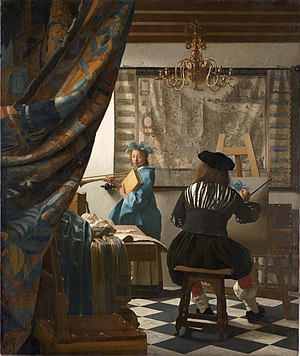
The term composition means "putting together". It can be thought of as the system of the elements of fine art according to the principles of art. Composition can utilise to whatsoever work of art, from music through writing and into photography, that is arranged using witting thought.
In the visual arts, limerick is often used interchangeably with various terms such as design, grade, visual ordering, or formal structure, depending on the context. In graphic blueprint for press and desktop publishing, composition is commonly referred to every bit page layout.
The limerick of a picture is different from its subject area (what is depicted), whether a moment from a story, a person or a identify. Many subjects, for example Saint George and the Dragon, are ofttimes portrayed in art, but using a great range of compositions even though the two figures are typically the only ones shown.
Elements of design [edit]
The cardinal visual element, known as element of design, formal element, or element of art, institute the vocabulary with which the visual creative person compose. These elements in the overall design usually relate to each other and to the whole art piece of work.
The elements of design are:
- Line — the visual path that enables the center to motion inside the slice
- Shape — areas defined by edges within the piece, whether geometric or organic
- Color — hues with their various values and intensities
- Texture — surface qualities which translate into tactile illusions
- Value — Shading used to emphasize form
- Form — 3-D length, width, or depth
- Infinite — the space taken upwardly by (positive) or in between (negative) objects
Line and shape [edit]

Lines are optical phenomena that permit the artist to direct the center of the viewer. The optical illusion of lines do exist in nature, and visual arts elements tin be arranged to create this illusion. The viewer unconsciously reads nigh the continuous arrangement of different elements and subjects at varying distances. Such elements can exist of dramatic employ in the limerick of the image. These could be literal lines such as telephone and ability cables or rigging on boats. Lines can likewise derive from the borders of dissimilar colors or dissimilarity or sequences of detached elements. Motility is also a source of lines, where the blurred motility renders equally a line.[1]
Subject lines contribute to both mood and linear perspective, giving the viewer the illusion of depth. Oblique lines convey a sense of movement, and angular lines generally convey dynamism and possibly tension. Lines can also directly attention towards the master subject of the picture or contribute to the organization by dividing it into compartments. The artist may exaggerate or create lines, possibly as role of their message to the viewer. Many lines without a clear discipline point suggest anarchy in the image and may conflict with the mood the artist is trying to evoke.[ citation needed ]
A line'due south angle and its relationship to the frame's size influence the perspective of the epitome. Horizontal lines, commonly constitute in mural photography, can requite the impression of calm, tranquility, and space. An prototype filled with strong vertical lines tends to have the appearance of height and grandeur. Tightly angled convergent lines give a dynamic, lively, and agile upshot to the epitome. Firmly turned, nigh diagonal lines produce tension in the picture. The viewpoint of visual art is fundamental because every dissimilar perspective views unlike angled lines. This modify of perspective elicits a different response to the image. Irresolute the air only by some degrees or some centimeters lines in embodiments tin can vary tremendously, and a distinct feeling can be transported. Directly lines are besides strongly influenced by tone, colour, and repetition concerning the residue of the image.
Compared to straight lines, curves provide a greater dynamic influence in a picture. They are also more often than not more than aesthetically pleasing, as the viewer associates them with softness. In photography, curved lines can requite graduated shadows when paired with soft-directional lighting, which usually results in a very harmonious line construction within the epitome. There are ii primary types of curves, a simple "C" bend as well as a more than sinuous "S" curve.[2]
Color [edit]
There are three backdrop of color: hue, brightness or chroma, and value. Hue is the name of a color (cherry-red, yellow, and bluish, etc.). Effulgence and chroma refer to the intensity and strength of the colour. A loftier chroma color is more pure and less greyed than a depression chroma colour. The lightness or darkness to a color is the value. Color likewise has the ability to work within our emotions. Given that, we can employ color to create mood. It tin also be used as tone, pattern, light, motility, symbol, form, harmony, and dissimilarity.[3] [4]
Texture [edit]
Texture refers to how an object feels or how information technology looks similar it may feel if it were touched. There are two ways we experience texture, physically and optically. Different techniques can be used to create concrete texture, which allows qualities of visual art to exist seen and felt. This can include surfaces such equally metal, sand, and wood. Optical texture is when the illusion of concrete texture is created. Photography, paintings, and drawings use visual texture to create a more realistic advent.[5]
Value [edit]
Lightness and darkness are known as value in visual art. Value deals with how lite reflects off objects and how we see it. The more light that is reflected, the higher the value. White is the highest or lightest value while blackness is the lowest or darkest value. Colors too accept value; for example, xanthous has a high value while blue and ruddy have a depression value. If yous take a black and white picture of a colorful scene, all you are left with are the values. This important element of pattern, particularly in painting and drawing, allows the artist to create the illusion of light through value contrast.[6]
Grade [edit]
The term form can mean different things in visual art. Grade suggests a three-dimensional object in infinite. It is likewise described as the physical nature of the artwork, such as sculptures. It tin can also be looked at as art form, which tin can be expressed through fine fine art. A form encloses volume, has length, width, and meridian, unlike a shape, which is only two-dimensional. Forms that are mathematical, a sphere, pyramid, cube, cylinder, and cone, are known as geometric forms. Organic forms are typically irregular and asymmetrical. This form tin can be found in nature, such as flowers, rocks, trees, etc., but can besides be seen in architecture.[7]
Forms in drawing and painting convey the illusion of three-dimensional form through lighting, shadows, value, and tone. The more contrast in value, the more pronounced the three-dimensional form is. Forms with footling value appear flatter than those with greater variation and contrasting.
Space [edit]
Space is the expanse effectually, above, and within an object. Photographers tin capture space, architects build infinite, and painters create space. This element is found in each of the visual arts. Information technology tin be positive or negative, open up or closed, shallow or deep, and two-dimensional or three-dimensional. In drawing or painting, space is not really there, just the illusion of it is. Positive space is the field of study of the piece. The empty spaces effectually, above, and inside, is negative space.[eight] [nine]
Principles of organization [edit]
The artist determines what the heart of interest (focus in photography) of the art work will be, and composes the elements appropriately. The gaze of the viewer will then tend to linger over these points of involvement, elements are arranged with consideration of several factors (known variously equally the principles of organisation, principles of art, or principles of design) into a harmonious whole which works together to produce the desired statement – a phenomenon usually referred to as unity. Such factors in limerick should not be dislocated with the elements of art (or elements of design) themselves. For example, shape is an element; the usage of shape is characterized by various principles.
Some principles of arrangement affecting the composition of a moving-picture show are:
- Shape and proportion
- Positioning/orientation/balance/harmony amongst the elements
- The surface area within the field of view used for the motion picture ("cropping")
- The path or direction followed by the viewer'south eye when they find the image.
- Negative infinite
- Color
- Contrast: the value, or caste of lightness and darkness, used inside the moving picture.
- Arrangement: for example, use of the golden mean or the rule of thirds
- Lines
- Rhythm
- Illumination or lighting
- Repetition (sometimes building into pattern; rhythm as well comes into play, equally does geometry)
- Perspective
- Breaking the rules can create tension or unease, nevertheless information technology tin can add interest to the motion picture if used carefully
Viewpoint (leading with the eye) [edit]
The position of the viewer can strongly influence the aesthetics of an image, even if the subject area is entirely imaginary and viewed "within the mind's center". Not only does it influence the elements within the picture, but it too influences the viewer's interpretation of the subject.
For example, if a male child is photographed from above, perhaps from the middle level of an developed, he is diminished in stature. A photograph taken at the child'southward level would treat him as an equal, and one taken from beneath could result in an impression of dominance. Therefore, the photographer is choosing the viewer's positioning.
A subject can be rendered more dramatic when it fills the frame. There exists a tendency to perceive things as larger than they actually are, and filling the frame fulfills this psychological mechanism. This tin be used to eliminate distractions from the groundwork.
In photography, altering the position of the camera tin change the image so that the bailiwick has fewer or more distractions with which to compete. This may be accomplished by getting closer, moving laterally, tilting, panning, or moving the camera vertically.
Compositional techniques [edit]
There are numerous approaches or "compositional techniques" to achieve a sense of unity within an artwork, depending on the goals of the artist. For case, a work of art is said to be aesthetically pleasing to the eye if the elements within the work are arranged in a balanced compositional way.[x] However, there are artists such as Salvador Dalí who aim to disrupt traditional composition and challenge the viewer to rethink balance and design elements within art works.
Conventional limerick can be achieved with a number of techniques:
Dominion of thirds [edit]
The rule of thirds is a composition guide that states that arranging the important features of an image on or near the horizontal and vertical lines that would divide the prototype into thirds horizontally and vertically is visually pleasing. The objective is to cease the subjects and areas of interest (such as the horizon) from bisecting the image, by placing them near i of the lines that would divide the image into three equal columns and rows, ideally near the intersection of those lines.

Rule of thirds: Note how the horizon falls close to the bottom filigree line, and how the nighttime areas are in the left third, the overexposed in the right third.
The rule of thirds is thought to exist a simplification of the aureate ratio. The golden ratio is thought to accept been used past artists throughout history as a composition guide, merely there is little testify to support this claim.
Rule of odds [edit]
The "rule of odds" suggests that an odd number of subjects in an image is more interesting than an fifty-fifty number. Thus if y'all take more than ane subject in your picture, the suggestion is to choose an organisation with at least three subjects. An fifty-fifty number of subjects produces symmetries in the prototype, which tin can appear less natural for a naturalistic, informal composition.
An image of a person surrounded/framed by 2 other persons, for example, where the person in the eye is the object of involvement in that image/artwork, is more likely to be perceived as friendly and comforting by the viewer, than an image of a single person with no significant surround.
Rule of space [edit]

Image of a racing car with lead room
The rule of infinite applies to artwork (photography, advertising, analogy) picturing objects to which the artist wants to apply the illusion of motion, or which is supposed to create a contextual bubble in the viewer's heed.
This can be achieved, for case, by leaving white space in the direction the optics of a portrayed person are looking, or, when picturing a runner, adding white infinite in forepart of him rather than behind him to indicate movement.
Simplification [edit]
Images with clutter tin can distract from the main elements within the picture and make information technology difficult to identify the subject. By decreasing the inapplicable content, the viewer is more probable to focus on the primary objects. Ataxia tin also be reduced through the use of lighting, as the brighter areas of the image tend to draw the eye, as exercise lines, squares and colour. In painting, the creative person may apply less detailed and defined brushwork towards the edges of the picture. Removing the elements to the focus of the object, taking only the needed components.
Shallow depth of field [edit]
In photography, and likewise (via software simulation of real lens limitations) in 3D graphics, one approach to achieving simplification is to utilize a wide aperture when shooting to limit the depth of field. When used properly in the right setting, this technique can place everything that is not the subject of the photo out of focus.
| The blurred background focuses the heart on the flowers. | At a smaller aperture, the background competes for the viewer's attention. |


A similar arroyo, given the right equipment, is to accept advantage of the Scheimpflug principle to change the plane of focus.
Geometry and symmetry [edit]

A simple composition with cloud and rooftop that creates asymmetry.
Related to the dominion of odds is the observation that triangles are an aesthetically pleasing implied shape within an image. In a canonically bonny face, the mouth and eyes fall within the corners of the area of an equilateral triangle.[ citation needed ] Paul Cézanne successfully used triangles in his compositions of still lifes. A triangular format creates a sense of stability and strength.
Creating motion [edit]
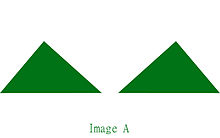
It is more often than not thought to be more pleasing to the viewer if the image encourages the centre to motion around the prototype, rather than immediately fixating on a single place or no identify in particular. Artists will often strive to avoid creating compositions that feel "static" or "apartment" by incorporating movement into the prototype. In image A the 2 mountains are every bit sized and positioned abreast each other creating a very static and uninteresting image. In image B the mountains are differently sized and ane is placed closer to the horizon, guiding the eye to motility from one mountain to the other creating a more interesting and pleasing image. This also feels more natural because in nature objects are rarely the same size and evenly spaced.

Other techniques [edit]
- There should exist a eye of interest or focus in the work, to prevent it becoming a blueprint in itself
- The direction followed by the viewer'due south eye should lead the viewer'due south gaze around all elements in the work earlier leading out of the movie
- The subject should not be facing out of the paradigm
- Verbal bisections of the picture space should exist avoided
- Minor, high dissimilarity, elements have as much bear upon every bit larger, duller elements
- The prominent subject should exist off-centre, unless a symmetrical or formal composition is desired, and can be balanced by smaller satellite elements
- The horizon line should not dissever the fine art work in two equal parts but be positioned to emphasize either the heaven or basis; showing more sky if painting is of clouds, sun rise/set, and more basis if a landscape
- Use of detailed areas and 'rest' areas can assistance to aid the middle in where to look. Creating a dissimilarity between detail and lack of detail is important
These principles tin can be means of a good composition yet they cannot exist applied separately but should act together to form a proficient composition.
- Also in an artwork, it is suggested that no spaces between the objects should be the same to create a more interesting paradigm.
Example [edit]
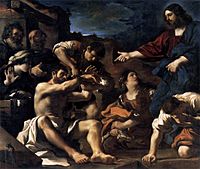
These paintings all show the same bailiwick, the Raising of Lazarus, and substantially the same figures, but have very different compositions:



See also [edit]
- Miksang (contemplative photography)
- New Epoch Notation Painting (a annotation system for painting)
- Page layout (graphic blueprint)
- CLACL (a computer linguistic communication for limerick)
- List of photographic limerick techniques
References [edit]
- ^ Wrigley, Alex. "How to Utilise Leading Lines in Your Photography Composition". Click and Learn Photography . Retrieved six Feb 2019.
- ^ Taylor, David (21 February 2015). Understanding Composition: The Expanded Guide. East Sussex: Ammonite Printing. p. 68. ISBN9781781451083.
- ^ Esaak, Shelley. "What is the Definition of Color in Art?". ThoughtCo . Retrieved March 8, 2017.
- ^ "Element of Pattern: Colour". Art Foundations. Archived from the original on 2018-12-23. Retrieved 2018-04-03 .
- ^ "The Visual Elements". Artyfactory.
- ^ Fussell, Matt. "The Elements of Art-"Value"". The Virtual Teacher.
- ^ Marder, Lisa. "What Does the Term 'Form' Mean in Regards to Fine art?". ThoughtCo . Retrieved January 23, 2018.
- ^ Esaak, Shelley. "Exploring the Spaces Between and Within The states". ThoughtCo . Retrieved February 19, 2018.
- ^ "What is Space?". Sophia. Sophia Learning.
- ^ Dunstan, Bernard. (1979). Composing Your Paintings. London, Studio Vista.
Farther reading [edit]
- Arnheim, Rudolf (1974). Fine art and Visual Perception: A Psychology of the Artistic Centre. University of California Press. ISBN978-0-520-02613-1.
- Downer, Marion (1947). Discovering Design. Lothrop Lee & Shepard. ISBN0-688-41266-ane.
- Graham, Peter (2004). An Introduction to Painting Still Life . Chartwell Books Inc. ISBN0-7858-1750-vi.
- Grill, Tom; Scanlon, Marker (1990). Photographic Limerick. Watson-Guptill Publications. ISBN0-8174-5427-half-dozen.
- Peterson, Bryan (1988). Learning to Encounter Creatively . Watson-Guptill Publications. ISBN0-8174-4177-8.
- Langford, Michael (1982). The Master Guide to Photography. New York: Dorling Kindersley Limited. ISBN0-394-50873-four.
External links [edit]
- Percy Principles of Art and Limerick, Goshen Higher Fine art Department
- Using Particular and why it is important
Source: https://en.wikipedia.org/wiki/Composition_(visual_arts)#:~:text=The%20term%20composition%20means%20%22putting,is%20arranged%20using%20conscious%20thought.
0 Response to "Composition Is the Term for the Organization of Visual Elements in Twodimensional Art"
Postar um comentário